
Projects
Ruth Bennett
Golden-winged Warbler Outreach on West Virginia's Private Lands
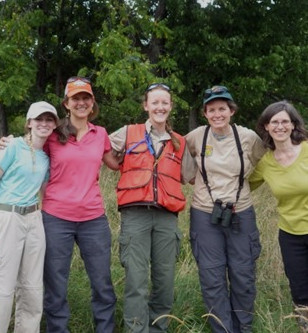
A team visits a landowner in West Virginia to consult on a potential WLFW GWWA project. Photo: Liz Brewer
Golden-winged Warblers thrive in dynamic forested landscapes that are a composition of mature forest and young, shrubby habitat such as found in regenerative clearcuts and boggy wetlands. Working with private landowners to create and maintain enough young forest habitat across the landscape is crucial to help recover declining Golden-winged Warbler populations. In West Virginia, 88% of the state’s 12 million acres of forest are privately owned. The scale of outreach needed to inspire enthusiasm for young forests could be a full-time job in West Virginia and, in fact, that was exactly what several partners decided the state needed. In 2019, a joint Outreach Forester position among Appalachian Mountains Joint Venture, National Wild Turkey Federation, and West Virginia Division of Forestry was created to coordinate outreach efforts for the USDA Natural Resources Conservation Service (NRCS) Working Lands for Wildlife (WLFW) Golden-winged Warbler Initiative.…
Golden-winged Warbler Adult Annual Survival Research Collaborative

A Nano-tagged female Golden-winged Warbler.Photo: Emily Filiberti
This collaborative effort aims to develop an integrated population model (IPM) for assessing the population viability and current and future breeding distribution of the Golden-winged Warbler using the latest advances in wildlife tracking technology. Traditional mark-recapture methods have proved insufficient for determining adult female survival – females are more difficult to recapture and detect in the field than male counterparts. Biologists across the Golden-winged Warbler breeding range are deploying VHF-radio tags to find the first reliable estimates of female Golden-winged Warbler survival…